
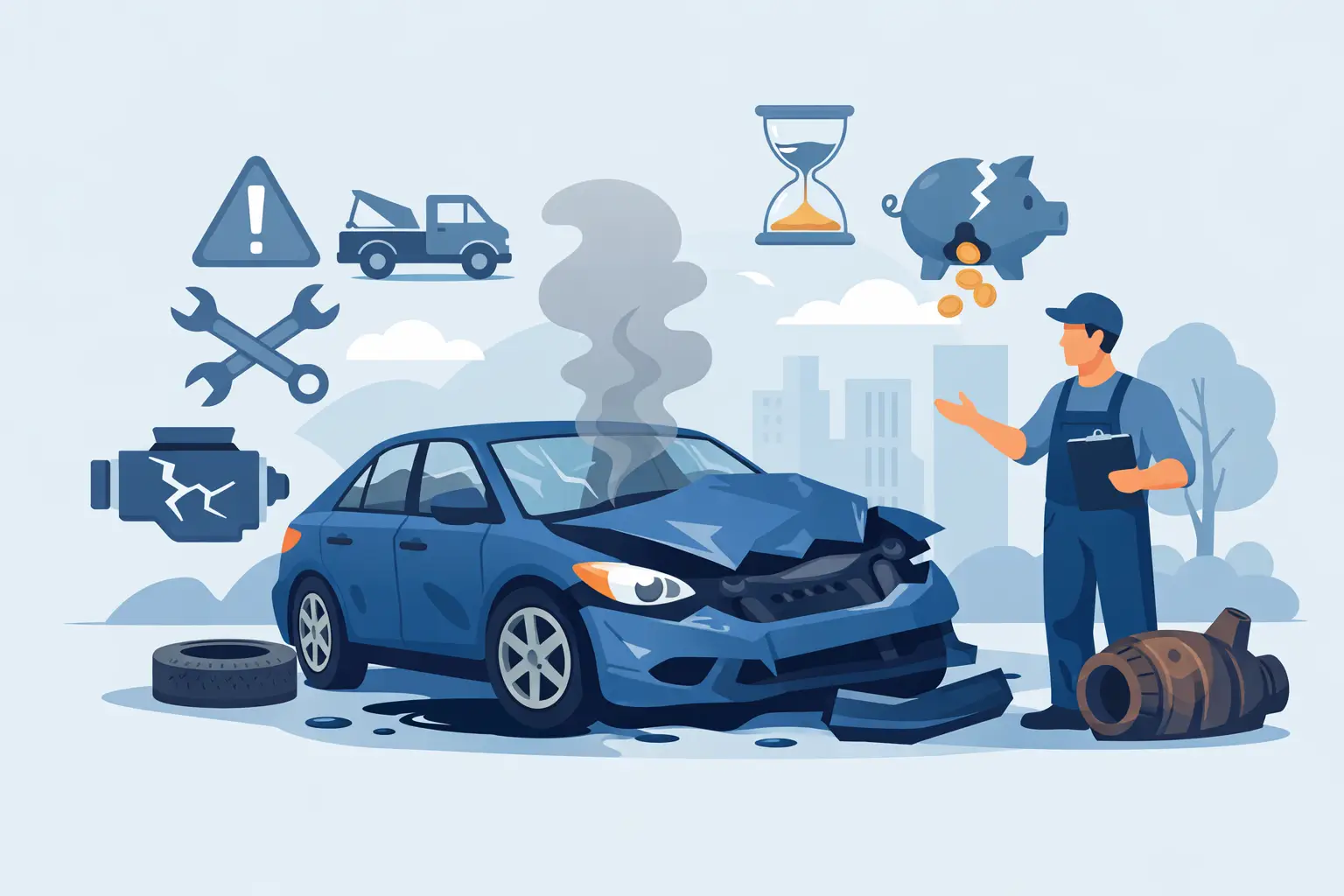
One big repair bill can feel like bad luck. Two or three in a row usually means something else. If you are searching for signs your car is beyond repair, you are probably already dealing with a vehicle that is costing more time, money and stress than it is worth.
The hard part is knowing when a car is merely old and temperamental, and when it has genuinely reached the end of the road. A lot of owners keep paying for fixes because they hope the next job will be the last one. Sometimes that works. Quite often, it does not.
When a car stops being worth repairing
A car does not have to be completely dead to be beyond repair. In real life, the decision is usually financial as much as mechanical. If the work needed is more than the vehicle is worth, if it is unsafe, or if faults keep stacking up, keeping it on the road may stop making sense.
That is especially true with older vehicles that have low market value, high mileage and a growing list of MOT advisories. Even if each issue can technically be fixed, the total cost can quickly overtake the value of the car itself.
9 signs your car is beyond repair
1. The repair costs are higher than the car’s value
This is usually the clearest sign. If your car is worth £1,000 and the garage quotes £1,800 for major repairs, the numbers are already telling you something. That is before any extra faults appear once work starts.
It is not always a strict one-to-one rule. Some people choose to repair a low-value car because replacing it would cost more. But if you are facing a big bill on a vehicle with little resale value, it is worth asking whether you are paying to keep a problem going.
2. The engine or gearbox has suffered major failure
A failed engine or gearbox can push a car into end-of-life territory very quickly. Rebuilding or replacing either is expensive, and on an older vehicle it often makes no financial sense.
Typical warning signs include severe knocking, loss of drive, heavy smoke, persistent overheating, slipping gears or complete non-start. If the engine and transmission are both tired, the decision becomes even easier. You may be looking at a car that is not worth saving.
3. Structural rust is affecting safety
Surface rust is one thing. Structural rust is another. If corrosion has reached the chassis, sills, suspension mounting points or other key areas, repairs can become extensive and costly.
Welding work soon adds up, and there is no guarantee rust will be limited to the first area found. On older cars, rust often spreads further than it first appears. If the shell is weakening, the vehicle may no longer be safe or economical to keep.
4. It keeps failing the MOT for serious issues
An MOT failure on its own does not mean the car is finished. Plenty of cars fail on tyres, bulbs or brakes and go back on the road without much fuss. The concern is when every MOT seems to uncover another round of expensive problems.
If your car is repeatedly failing on major items such as corrosion, emissions, suspension, steering or brake system faults, that pattern matters. It suggests the vehicle is wearing out across several systems at once, not just suffering from one isolated problem.
5. Electrical faults are becoming constant
Electrical problems can be among the most frustrating and expensive to diagnose. One week it is the battery light, the next week the central locking stops working, then the dashboard lights come on and the car will not start.
Modern cars rely on sensors, control units and complex wiring. Once electrical faults become intermittent or widespread, labour costs can rise quickly because finding the root cause takes time. If the issues keep returning after repairs, it may be a sign the car is no longer a sensible investment.
6. The car is no longer reliable enough for daily use
Reliability matters just as much as the repair invoice. If you cannot trust the car to start in the morning, get you to work or carry the family safely, its value to you has already dropped.
A vehicle can still drive and yet be beyond practical repair. Constant breakdowns, warning lights, fluid leaks and recovery call-outs are a sign that the car is becoming a liability. At that point, you are not just paying in garage bills. You are paying in disruption as well.
7. It has serious accident damage
After a heavy impact, repair costs can be far higher than they first appear. Damage to body panels is one thing, but if the chassis, suspension geometry, steering components or mounting points are affected, the repair becomes much more involved.
Insurers often write vehicles off for this reason. Even if the car could be repaired, the cost and complexity may not justify it. If accident damage has affected the structure or safety systems, moving on is usually the more sensible option.
8. It has high mileage and several ageing components
High mileage alone does not mean a car is finished. Plenty of well-maintained cars cover impressive distances. The issue is high mileage combined with multiple ageing parts.
If the clutch is worn, the suspension is tired, the exhaust is failing, the timing components are due and the engine is burning oil, you are not dealing with a single repair. You are dealing with a queue of them. In that situation, even a currently running car may be on borrowed time.
9. The repair list keeps growing faster than you can clear it
This is one of the most common signs your car is beyond repair, even if no single fault looks catastrophic on paper. The car goes in for one issue and comes back with three advisories. You fix two things, then another problem appears a month later.
That cycle usually means overall wear has caught up with the vehicle. You are no longer maintaining it in a normal way. You are trying to hold back a steady decline. For most owners, that is the point where scrapping the car becomes the simpler and cheaper decision.
Repair or scrap – what should you weigh up?
The right choice depends on the car, the fault and what you need from it. If the vehicle is otherwise sound, has decent value and only needs one major repair, fixing it may still be reasonable. The same applies if you know its history and want to avoid the cost of replacing it.
But if the car has low value, major faults and a poor MOT outlook, scrapping it can be the practical answer. You avoid sinking more money into a vehicle that may still let you down next month. You also avoid the hassle of trying to sell a non-runner privately.
It helps to compare three things honestly: the repair quote, the current value of the car, and the likelihood of more faults appearing soon. If the numbers and the risk both look bad, there is not much sense in delaying the decision.
Signs your car is beyond repair for everyday owners
For most people, this decision is not really about mechanics. It is about whether the car still fits normal life. If it is stranded on the drive, fails the MOT, will not start reliably or needs money every few weeks, it has stopped being useful.
That is often when owners in Peterborough and nearby areas choose to get a scrap quote instead of booking another repair. A straightforward collection and quick payment can be far easier than arranging recovery, chasing garages and hoping the next fix finally solves it.
What to do next if your car is beyond repair
Start by getting a clear view of the vehicle’s condition. If you already have a garage quote or MOT failure sheet, use that as your baseline. Check the likely value of the car in working order, then compare it with the cost of putting it right.
If the maths does not work, the next step is usually disposal rather than repair. A professional scrap service should make that simple – quote the vehicle from the registration and postcode, collect it from your home or another location, and handle the paperwork properly. That matters even more when the car is non-running or unroadworthy.
There is no prize for keeping a failing car going longer than you need to. Sometimes the smartest move is the most practical one: stop paying for a vehicle that has had its time, get it collected, and move on without more hassle.
Leave a Reply