
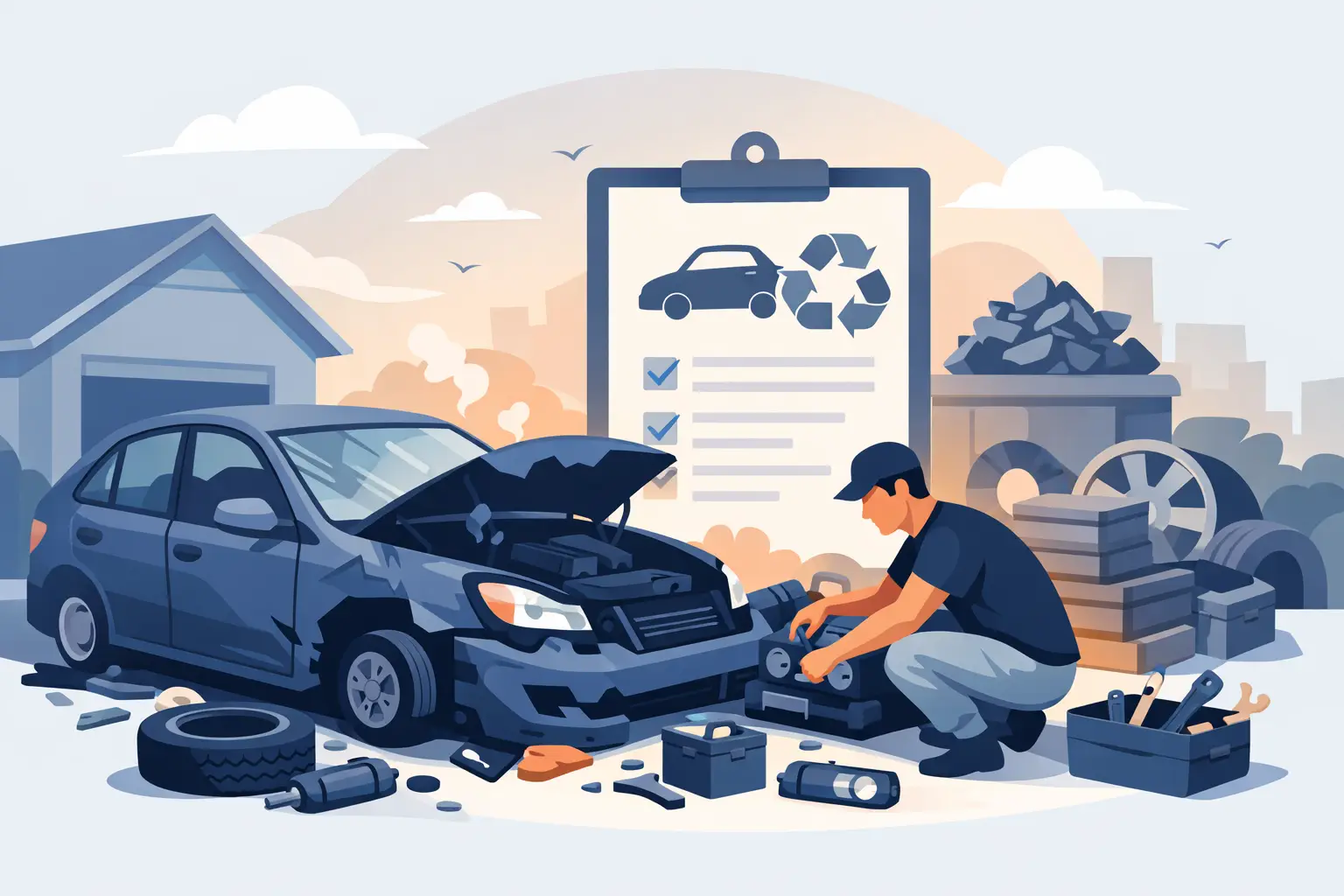
A car that will not start is bad enough. A car that will not start and now needs moving is where the real hassle begins. If you need to scrap broken car without towing, the good news is you do not need to arrange a recovery vehicle, push it onto a trailer, or pay extra just to get rid of it. The right scrappage service can collect it from your home, workplace, roadside location or garage and handle the process properly from start to finish.
For most owners, that is the difference between a quick sale and a problem that sits on the drive for weeks. When the vehicle is no longer worth repairing, the simplest option is usually the best one.
Can you scrap a broken car without towing?
Yes, you can – as long as you use a buyer that offers vehicle collection. This is especially useful if the car is a non-runner, has failed mechanically, has accident damage, or is no longer roadworthy.
A lot of people assume they need to sort transport first and only then look for a scrap quote. In practice, it often works the other way round. Many scrappage services collect vehicles as part of the sale, which means towing is not something you need to organise separately.
That matters because private towing costs can quickly eat into the value of the car. If your vehicle is only worth a modest scrap return, paying for recovery can make the whole thing feel pointless. Free collection removes that barrier and makes the sale worthwhile again.
Why towing your broken car yourself often makes no sense
If a car does not drive, moving it yourself is rarely the cheaper or easier route. You may need a recovery firm, access to a trailer, someone available to meet the driver, and enough space for collection. If the car is parked awkwardly, has flat tyres, or has been sitting unused for months, the job gets even more difficult.
There is also the legal side. A broken or unroadworthy car should not simply be dragged onto the road and driven somewhere “just this once”. If it is not fit to be on the road, it should be collected properly.
This is why many sellers choose a service built around collection. It saves time, avoids extra costs and removes the risk of trying to solve a transport problem that should not be yours to solve in the first place.
How to scrap broken car without towing in the UK
The process is usually much simpler than people expect. In most cases, you only need your registration and postcode to get started. From there, the buyer can work out the likely value of the vehicle and arrange collection if you accept the quote.
Once booked, a collection partner comes to the vehicle rather than asking you to bring the vehicle to them. That is the key point. If you are trying to scrap broken car without towing, you want a service that is set up to collect non-runners as standard, not as an expensive add-on.
Payment is normally made by bank transfer, and the paperwork should be handled in line with UK scrappage rules. That includes confirming the vehicle has been passed into the correct disposal process.
What affects the price of a broken scrap car?
A broken car is not automatically worthless. The offer depends on several practical factors, and it is not always as simple as age alone.
Weight still matters because scrap value is partly linked to metal content. Make and model can also change the price, as some vehicles are in stronger demand within recycling networks than others. Condition matters too, but not in the same way it would with a private sale. A missing engine, serious fire damage or stripped interior may reduce the offer more than a failed clutch or dead battery.
Location can also play a part. A buyer with strong collection coverage can often offer better value because they can move vehicles efficiently. That is one reason network-based services can be useful – they compare routes and buyers rather than relying on one local outlet only.
What you need before collection
You do not need to overcomplicate this, but a few things help the process run smoothly. The registration number is essential, and having the V5C logbook is helpful if you still have it. If you do not, many buyers can still advise you on the correct next step.
You should also remove personal belongings from the car before collection. Check the glovebox, boot, door pockets and under seats. Old paperwork, parking permits, charging cables, sunglasses and house keys have a habit of turning up in forgotten places.
If the vehicle is blocked in, let the buyer know when booking. The same goes for missing wheels, steering lock issues or access restrictions. A good service would rather know in advance than arrive to surprises on the day.
Paperwork matters more than most people think
The practical side of collection is only half the job. The other half is making sure the vehicle leaves your name properly and goes through the right disposal route.
That is why official paperwork support matters. You should know who is collecting the vehicle, how the transfer is being recorded, and what happens next. If a service is vague about documentation, that is a warning sign.
A professional scrappage company should make this straightforward, not confusing. The point is convenience, but convenience should not come at the cost of compliance. You want the car gone, the payment made promptly, and the paperwork handled properly so there is nothing lingering afterwards.
When scrapping is better than repairing
Some owners hesitate because they think one more garage visit might save the car. Sometimes that is true. Often, it is not.
If the repair cost is close to or above the value of the vehicle, scrapping usually makes more sense. The same applies when there are several faults building up at once – perhaps a failed MOT, electrical issues, clutch problems and corrosion underneath. Even if one repair is manageable, the next one may not be far behind.
There is also the time factor. If the car has already been off the road for days or weeks, every delay means more inconvenience. You are still dealing with parking space, insurance decisions, and the nagging problem of what to do next. At a certain point, fast collection and quick payment become more useful than chasing another uncertain repair.
Choosing the right collection service
Not every buyer offers the same level of service, and this is where details matter. If your main goal is to scrap a broken car without towing, look beyond the headline quote.
Ask whether collection is free. Ask how quickly it can be arranged. Ask whether they collect seven days a week and whether non-running vehicles are accepted without extra hassle. A slightly higher quote can lose its appeal very quickly if there are hidden collection charges or delays.
You also want a service that communicates clearly. You should know when collection is happening, how payment is made and what documents are needed. Straight answers are usually a good sign that the process will be as simple as promised.
For sellers who want speed without complications, Scrap Cars Peterborough offers the kind of quote-and-collection process that removes the towing problem altogether. That matters most when your car is already off the road and you just want it dealt with.
Common concerns from owners of non-runners
One of the biggest worries is whether a broken car is “too far gone” to collect. In most cases, the answer is no. Non-starting cars, MOT failures, accident-damaged vehicles and end-of-life cars are exactly the kind of vehicles collection services deal with every day.
Another common concern is payment. Owners understandably want to know they will not hand over the car and then wait around. A professional service should be clear about when payment is made and how it reaches you.
Then there is timing. People often imagine scrappage as something that takes days of chasing. It does not need to. When the service is organised properly, the quote, booking, collection and payment can move quickly.
The simplest route is usually the best one
If your car no longer runs, there is no prize for making the process harder than it needs to be. Paying for towing, trying to arrange transport yourself, or leaving the vehicle to sit unused rarely adds value. It usually just adds delay.
The better option is to use a service that prices the car fairly, collects it from where it stands, and handles the paperwork without fuss. When that happens, a broken car stops being a burden and becomes a straightforward sale.
If your vehicle is finished, let it be finished properly – with collection arranged, payment made promptly and no towing headache to sort out first.
Leave a Reply