
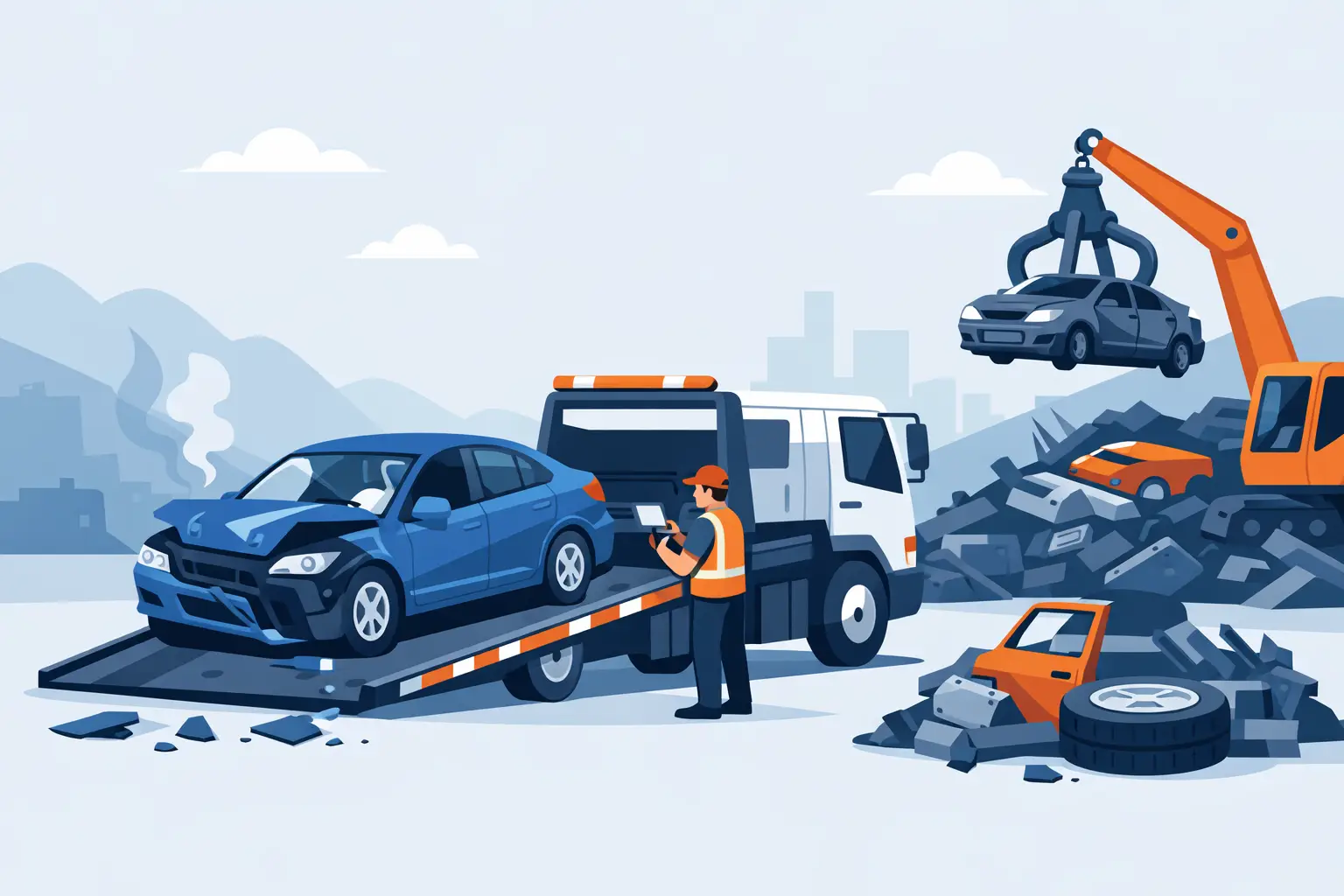
A car can go from daily runaround to driveway problem in a single crash. If the repair bill is too high, the insurer has written it off, or the vehicle is no longer safe or economical to keep, knowing how to scrap accident damaged car the right way saves time, stress and wasted money.
The good news is that scrapping an accident-damaged vehicle is usually straightforward when you use a professional service. You do not need to arrange a buyer, pay for towing, or guess your way through the paperwork. What matters is understanding the process, knowing what affects value, and making sure the car is collected and disposed of properly.
How to scrap an accident damaged car in the UK
If your car has been in an accident, the first step is to work out whether it is genuinely ready for scrappage. Some damaged vehicles still have resale value, especially if the damage is cosmetic or limited to one area. Others are simply not worth repairing once you factor in labour, parts, MOT issues and the risk of more faults appearing later.
In most cases, owners scrap accident-damaged cars for one of three reasons. The vehicle is an insurance write-off, it is too expensive to repair, or it no longer drives and getting it moved is a hassle. If that sounds familiar, the quickest route is to get a scrap quote from a service that collects non-runners and handles the DVLA side correctly.
You will normally be asked for the registration number and your postcode. From there, a quote can be based on the vehicle’s details, current scrap market conditions and whether collection is needed. If the car has significant collision damage, be honest about its condition from the start. Accurate information helps avoid price changes later.
Once you accept the quote, a collection is booked. If the car cannot be driven, that is not usually a problem. A proper scrap collection service should be able to pick it up from your home, workplace, garage or recovery yard. Payment is then made by bank transfer, and the relevant scrappage paperwork is completed.
What affects the scrap value after an accident
A damaged car is not valued in the same way as a tidy used car. Condition still matters, but scrap prices are mainly influenced by weight, make, model, age, completeness and demand across the recycling network.
A heavier vehicle often brings a better return because there is more recyclable material in it. Newer cars can also achieve stronger prices, even when accident damaged, because they may still hold value as end-of-life vehicles with reusable materials and components in the wider authorised treatment process. Popular makes and models can also perform better than you might expect.
That said, severe crash damage can reduce value. A burnt-out car, a vehicle with major front and rear impact, or one missing major parts may be worth less than a complete non-runner with moderate damage. This is where people often get caught out. They assume any write-off is worthless, when in reality there can still be a fair amount of value in it. Equally, some expect a strong payout because the car was expensive a few years ago, even though the current condition says otherwise.
It depends on the vehicle and the damage. That is why a proper quote based on the registration and location is usually the best place to start.
Documents you usually need
Paperwork worries put a lot of owners off, especially after an accident when there is already enough to deal with. In practice, the process is simpler than many people expect.
The main document is usually the V5C logbook, if you have it. If you do not, you can still scrap the vehicle, but you should tell the buyer in advance. You may also be asked for proof of identity, and you should make sure the details you give match the vehicle being collected.
If the car has been written off by an insurer and then retained by you, be clear about that when requesting a quote. The scrappage service can then tell you exactly what is needed. The key point is that the vehicle should go through a compliant process, and you should have confirmation that you are no longer responsible for it once the transfer is complete.
Avoiding the common mistakes
The biggest mistake is leaving the car to sit for weeks while you decide what to do. Damaged cars tend not to become easier to sell with time. They take up space, can leak fluids, may attract storage charges if they are not on your property, and often become more of a burden the longer they are left.
Another common mistake is trying to sell privately when the vehicle is clearly better suited to scrappage. Private buyers of accident-damaged cars often want a very low price, expect you to answer endless questions, and may still expect you to help with moving the vehicle. For many owners, that route creates more hassle than value.
You should also be wary of vague offers that sound high but are not backed by proper collection and payment terms. A fair quote is only useful if the service can actually turn up, remove the vehicle and pay promptly. Fast collection and clear bank payment matter just as much as the headline number.
How collection works when the car does not drive
This is one of the biggest concerns for people dealing with an accident-damaged vehicle. If the suspension is damaged, the wheel is bent, the engine will not start or the car is simply not roadworthy, you should not be expected to sort out transport yourself.
A professional scrap collection service will arrange recovery for you. That means the vehicle can be picked up from where it is, whether that is your drive, a garage, a body shop or another safe location. You agree the collection time, hand over the vehicle, and the rest is handled for you.
For owners in and around Peterborough, this kind of service makes a real difference. You avoid the cost and inconvenience of moving an unroadworthy car yourself, and you can get the matter closed quickly instead of spending days chasing recovery options.
Insurance write-off categories and scrappage
If your insurer has written the car off, the category can influence what happens next. Some vehicles are only suitable for scrappage, while others may technically be repairable. But from an owner’s point of view, the practical question is usually simpler – is it worth any more of your time and money?
If the answer is no, scrapping it can be the cleanest option. It gives you a definite end point. There is no arranging repairs, no re-listing, no dealing with tyre-kickers, and no trying to recover value from a car you no longer want to keep.
If you are unsure, ask for a quote before making assumptions. Seeing a real figure often makes the decision easier.
A simple way to scrap an accident damaged car
The easiest approach is to keep it practical. Get a quote, confirm the condition honestly, book free collection and make sure the payment and paperwork are handled properly. That is the route most people want after an accident – quick, clear and with as little disruption as possible.
This is where a service like Scrap Cars Peterborough fits well. The process is designed for owners who want rid of a damaged, non-running or written-off vehicle without dragging it through a long sales process. You can get a quote quickly, arrange collection seven days a week, and avoid the usual back-and-forth that comes with trying to sort it out yourself.
If your car is sitting damaged on the drive and you already know you are not repairing it, there is not much to gain by waiting. Get the valuation, check the collection details, and move it on properly. A crashed car is stressful enough – the disposal part should be the easy bit.
When you are ready to let it go, the best option is usually the one that saves time, removes hassle and gets the vehicle dealt with correctly the first time.
Leave a Reply