

April 26, 2026
How to Book Car Collection Without the Hassle
Learn how to book car collection quickly, what details you need, how payment works, and what to expect…
Read article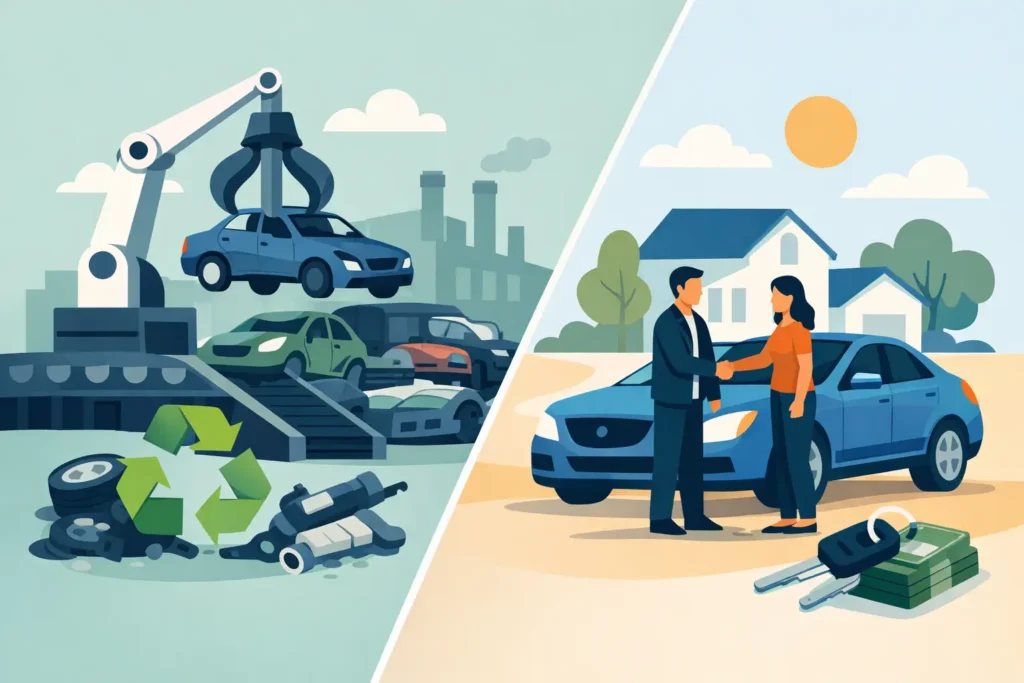
A car that has failed its MOT, stopped starting on the drive, or become too expensive to repair raises a very practical question: vehicle recycling vs private sale. Most owners are not weighing up theory. They want to know which route gets the vehicle gone quickly, what they are likely to be paid, and how much stress comes with the process.
The honest answer is that both options can work. It depends on the condition of the vehicle, how much time you have, and how willing you are to deal with buyers, paperwork, viewings and transport. If your car is old but still usable, a private sale may return more. If it is damaged, non-running or clearly at the end of its life, recycling is often the faster and cleaner option.
On paper, a private sale sounds simple. You advertise the car, answer messages, arrange viewings, agree a price and complete the sale. For a decent used vehicle with service history and a current MOT, that can be worth the effort.
In real life, the process is rarely that tidy when the car is unwanted, unreliable or off the road. Buyers ask if it drives perfectly, whether they can haggle on arrival, or if you can somehow deliver it. Some never turn up. Others want a bargain because they know the seller wants the car gone.
Vehicle recycling is different. The value is based more on the vehicle’s age, weight, condition, make, model and recoverable materials than on whether it looks attractive in an advert. That means it can be a far more realistic route for cars with mechanical faults, accident damage, missing parts or no MOT.
If your priority is maximum return and the car still has proper resale value, private sale deserves a look. If your priority is speed, collection and less back-and-forth, recycling usually makes more sense.
A private sale is usually strongest when the car is roadworthy, presentable and likely to appeal to ordinary buyers rather than traders. If it starts reliably, drives well, has a reasonable service record and does not need major work, there is a market for it.
That is especially true if the vehicle is in a price bracket where buyers expect to purchase from another private owner. In those cases, the extra money can justify the extra effort. A seller with time, patience and confidence in dealing with enquiries may do well.
There is a trade-off, though. The headline price in an advert is not the same as money in your bank. Buyers negotiate. They spot cosmetic marks. They question old advisories on the MOT history. If the car has any obvious faults, even minor ones, the discount they want can be much bigger than expected.
You also need to be realistic about your own time. Writing the advert, taking photographs, replying to messages and arranging viewings can stretch over days or weeks. That may be fine if the car is sitting on your drive and you are in no rush. It is less appealing if the vehicle is blocking space, cannot be driven, or has already become a nuisance.
Vehicle recycling becomes the practical choice when the car has dropped out of the normal used-car market. Common examples include non-runners, accident-damaged vehicles, MOT failures, flood-damaged cars, cars with engine or gearbox problems, and vehicles that would cost more to fix than they are worth.
In those cases, chasing a private buyer can become a frustrating cycle. You may attract people looking for a cheap project, but many will expect a very low price. Some will not understand the true condition until they arrive. Others will ask for endless details and then disappear.
Recycling cuts through that. A professional service can quote from the registration and postcode, arrange collection, and pay promptly once the vehicle is confirmed. For owners dealing with a stressful breakdown or a car that has been sitting unused for months, that simplicity matters.
It also matters when the vehicle is unroadworthy. If it cannot legally or safely be driven, private sale becomes harder because transport becomes your problem unless the buyer arranges it. With recycling, collection is normally built into the process, which removes one of the biggest headaches straight away.
For a car in decent working order, private sale often has the higher ceiling. You are selling the vehicle as a usable car, not simply for recycling value. If demand is strong and the condition is good, you may achieve more than a recycler would offer.
For a car in poor condition, that comparison changes quickly. Once repair costs, transport issues and buyer reluctance enter the picture, the gap can shrink or disappear. A vehicle that looks like it should fetch a few hundred pounds privately may struggle to sell at all if it needs serious work.
That is where owners can lose time and money together. They hold out for a better price, keep paying insurance or storage, and still end up accepting less later. A fair recycling quote can be better value overall because it is immediate, realistic and does not depend on finding the one buyer willing to take on the risk.
The strongest approach is to judge the actual market, not the hoped-for one. Ask what the car is worth in its present state, not what it might be worth if repaired, cleaned up or sold to the perfect buyer who may never appear.
This is often the deciding factor.
Private sale usually asks more from you at every stage. You handle the advert, calls, messages, viewings, price negotiation and handover. If anything is unclear, you are the one sorting it out. For some sellers that is manageable. For others, it is exactly what they want to avoid.
Vehicle recycling is built around reducing friction. If your car is damaged or unwanted, a quick quote, free collection and fast payment are usually worth more than stretching the process for a little extra. That is particularly true if the vehicle no longer starts, has already failed an MOT badly, or is taking up space at home, at a garage or on a family member’s drive.
For local owners around Peterborough and nearby areas, convenience is not just a buzzword. It means not having to arrange recovery yourself, not waiting in all week for unreliable buyers, and not trying to work out the disposal rules alone.
Paperwork is another area where the difference is clear.
With a private sale, you need to complete the ownership transfer correctly and keep proper records of the sale. You also need to be careful about how the vehicle is described. If you gloss over faults to make the advert more attractive, you invite disputes. Even honest sales can become awkward if the buyer later complains.
With vehicle recycling, the process is generally more straightforward when handled by a professional operator. The vehicle is collected, processed through the proper channels and the disposal side is managed in line with legal requirements. For many owners, that reassurance is as important as the price.
This matters even more with end-of-life vehicles. Once a car is clearly beyond sensible repair, the goal is not just to sell it. The goal is to dispose of it properly, with less risk of the vehicle being passed around informally or creating problems later.
If your vehicle is clean, roadworthy and likely to attract genuine buyers, private sale may be worth the extra effort. You could make more, provided you are happy to handle the process and wait for the right offer.
If the car is damaged, old, unreliable, non-running or simply not worth the hassle of advertising, recycling is often the smarter move. It gives you a clear route out, usually with collection, quick payment and less uncertainty.
That is why many sellers end up choosing convenience over chasing a slightly better number. When a car has become a problem rather than an asset, speed and certainty count for a lot. Scrap Cars Peterborough works with owners in exactly that position, helping them move unwanted vehicles on without dragging the process out.
A useful rule is this: if you would feel confident recommending the car to a friend, try a private sale. If you are already explaining away faults before anyone has even seen it, recycling is probably the better fit.
The right choice is the one that suits the car you actually have, your timescale, and how much hassle you are prepared to take on. Getting rid of an unwanted vehicle should feel like one less job on your list, not a new one.
Ready to get a fair price for your scrap car?
Get a Free Quote
Learn how to book car collection quickly, what details you need, how payment works, and what to expect…
Read article
Scrap cars Whittlesey made simple with fast quotes, free collection and quick payment for damaged, old or non-running…
Read article
The future of vehicle recycling is changing fast in the UK, with better recovery, EV battery handling and…
Read article