
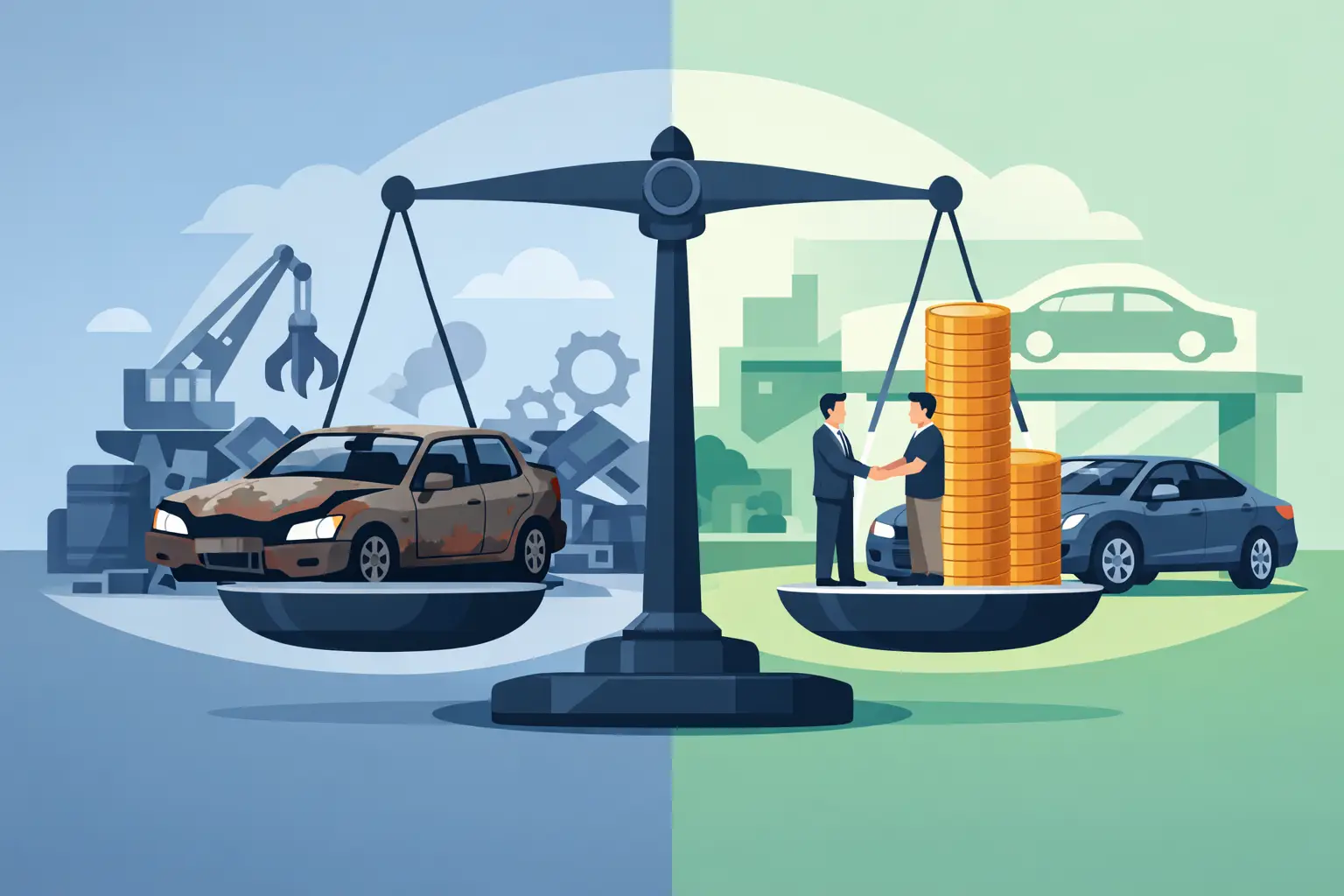
You do not need to love your old car to want a fair price for it. When it is failing MOTs, sitting on the drive, or no longer worth repairing, the real question becomes simple: scrap car vs trade in – which one actually makes more sense for your situation?
The answer depends on the car’s age, condition, value on the retail market, and how quickly you want it gone. A trade-in can work well if the vehicle still has resale appeal and you are already buying another car from a dealer. Scrapping is often the better route when the car is damaged, non-running, uneconomical to repair, or worth more in metal and parts value than as a used vehicle. The mistake many sellers make is assuming one option is always better. It is not.
Scrap car vs trade in: what is the real difference?
A trade-in is part exchange. You hand your current car to a dealer and its value is deducted from the price of the next vehicle you are buying. It is convenient because it folds the old car sale into the purchase of a new one. There is less admin, less time spent advertising, and no need to deal with private buyers.
Scrapping a car is different. You are selling it for salvage or recycling value, usually because it is at the end of its useful life, has serious mechanical faults, accident damage, or is simply not worth putting back on the road. The focus is not retail resale value. It is what the vehicle is worth as scrap metal, recyclable materials, and recoverable components within a compliant vehicle recycling process.
If your car still starts, drives well, has a valid MOT, and would sit comfortably on a used forecourt, a trade-in may be viable. If it has become a headache, scrapping is often the cleaner and faster answer.
When a trade-in makes sense
A trade-in tends to suit cars that still have a straightforward second-hand market. Dealers want stock they can prepare and resell without spending too much. If your car is in decent condition, has sensible mileage for its age, and does not need major work, you may get a reasonable offer.
This option also appeals to people who value convenience over squeezing out every last pound. If you are replacing your car anyway, doing everything in one transaction can save time. There is no separate collection to arrange and no need to keep the car insured while you wait for a buyer.
That said, trade-in offers are usually shaped by the dealer’s margin. They are not buying your car out of goodwill. They need room for preparation costs, warranty risk, resale time, and profit. So even when trade-in works, it does not always mean best value.
There is another point many people overlook. Some dealers are less interested in older cars with warning lights on, cosmetic damage, clutch issues, gearbox faults, or failed MOTs. They may still accept them, but the offer can be low because they are pricing in the hassle.
When scrapping is the better option
Scrapping becomes more attractive when the car’s road value has dropped below the cost and effort of keeping it going. This is common with older diesel cars, vehicles with engine or transmission faults, insurance write-offs, and cars that have been standing unused for months.
If the car does not run, a trade-in becomes harder. Some dealers will simply refuse it. Others may offer a token amount just to move the conversation along. In that case, a proper scrap quote can be stronger because the buyer is assessing it for recycling and salvage value rather than forecourt resale.
This is where speed matters too. If the vehicle is taking up space, cannot legally be driven, or needs collecting from home, work, or a garage, scrapping is often the least stressful route. For many sellers, that practical advantage matters as much as the final figure.
A local owner in Peterborough with a non-runner on the drive usually does not want to organise transport, haggle with a dealer, and sort out paperwork alone. They want a price, a collection time, and payment without the usual back and forth. That is exactly why scrappage services exist.
Which pays more?
This is the part everyone wants a straight answer on. In a scrap car vs trade in comparison, the higher payout depends on the type of vehicle.
If your car still has decent retail demand, trade-in may pay more than scrap value. A ten-year-old hatchback with service history, moderate mileage, and no major faults is usually worth more as a used car than as scrap.
If your car has serious faults or poor resale prospects, scrapping can pay more. A failed engine, a cracked head gasket, severe corrosion, electrical faults, accident damage, or repeated MOT failures can wipe out trade-in appeal very quickly. Once repair costs outweigh resale potential, the dealer offer often collapses. At that point, scrap value can be the stronger number.
It also depends on whether the dealer is being realistic. Some part exchange offers look generous but are balanced by less discount on the car you are buying. Others look poor because the dealer simply does not want your old car. The only useful way to compare is to look at the full deal, not just the headline figure.
The hidden costs behind both options
People often compare offers without factoring in hassle, delays, and extra costs. That can distort the decision.
With a trade-in, the hidden compromise is usually price. You gain convenience, but the dealer controls the valuation and the terms of the wider sale. If your old car is weak stock, that will show in the offer.
With scrapping, the process is usually more direct, but you need a service that handles collection properly and pays promptly. If the vehicle is not roadworthy, free collection makes a real difference. Otherwise, transport charges can eat into the value.
Paperwork matters as well. When a car is being scrapped, sellers want the process handled correctly so the vehicle is disposed of through the proper channels and ownership responsibility is clear. If you are already dealing with a broken vehicle, the last thing you want is confusion after collection.
How to decide quickly
A practical way to decide is to ask two questions. First, would a dealer realistically want to retail this car? Second, is it worth spending any more money on it?
If the answer to the first question is yes, get a trade-in figure and compare it with a scrap quote. If the answer is no, or you already know the car is uneconomical to repair, scrapping is likely the better fit.
Be honest about the car’s condition. Owners often remember what they spent on repairs last year and assume that value still exists. Buyers do not work like that. They price the car based on what it is now, not what it has cost you in the past.
It also helps to think about timing. If you need the car gone this week, or it is blocking a space and costing you money in storage, tax, or insurance, a fast scrap collection can be worth more overall than waiting for a slightly different trade-in outcome.
Scrap car vs trade in for damaged and non-running vehicles
This is where the gap becomes clearer. For damaged, written-off, or non-running vehicles, trade-in is often the awkward option. Dealers may not want the risk, may undervalue the car heavily, or may only accept it as a favour to secure the sale of another vehicle.
Scrappage services are set up for exactly these cases. The valuation is based on the vehicle as it stands, and collection is part of the process. That removes the biggest obstacle for owners of cars that cannot be driven.
For many people, that matters more than anything else. A fair quote is one thing. A fair quote with free collection, quick bank payment, and help with the official side of the process is what turns a stressful job into a simple one.
The better choice is the one that fits the car
There is no universal winner in a scrap car vs trade in decision. A usable car with solid resale appeal may suit part exchange. An old, damaged, unreliable, or non-running vehicle usually suits scrapping better, especially when speed and convenience matter.
If you are unsure, compare both routes honestly and focus on the real-world result, not just the label. The best option is the one that gives you a fair return, removes the hassle, and gets the car dealt with properly so you can move on.
Leave a Reply