
April 9, 2026
How Does Scrap Car Collection Work?
Find out how does scrap car collection work, from quote to pickup, payment and DVLA paperwork, so you…
Read article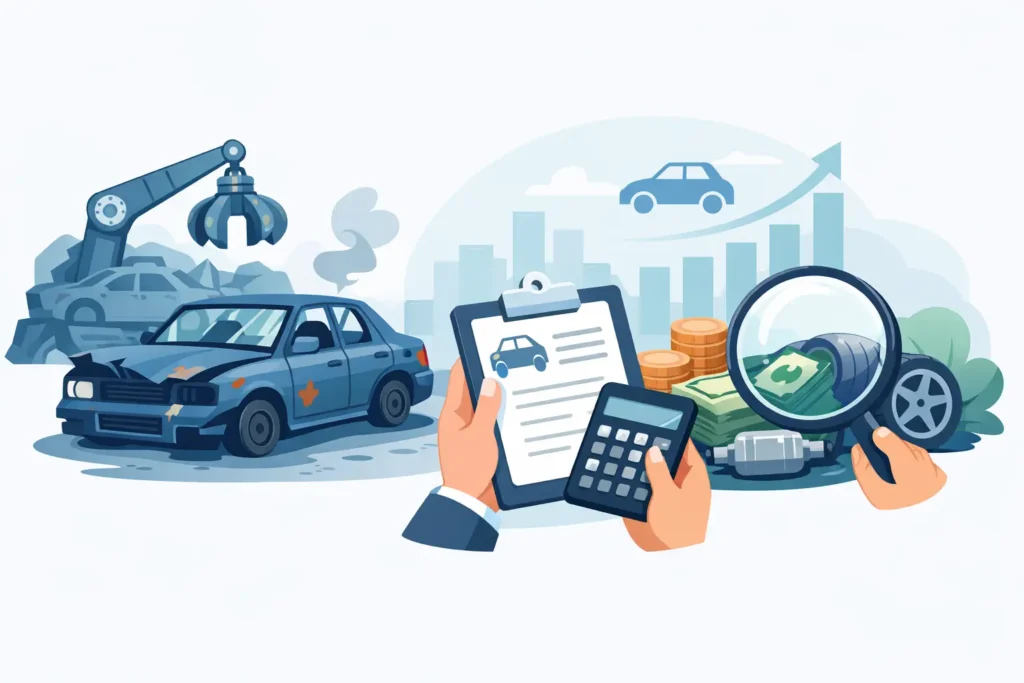
That old car on the drive is not just taking up space – it has a value, and that value can vary more than most people expect. If you are trying to work out how to value scrap vehicle correctly, the key is knowing what buyers are actually paying for. It is rarely just the age of the car. Weight, metal prices, missing parts, damage, demand for reusable components and collection logistics all play a part.
For most private owners, the difficult part is not getting rid of the vehicle. It is knowing whether the quote in front of them is fair. A non-runner with body damage might still be worth a decent amount, while an older car that looks complete can come in lower than expected if key parts are missing. Once you understand what affects price, it becomes much easier to judge an offer and act quickly with confidence.
The fastest way to think about scrap value is to split it into two parts. First, there is the raw scrap value of the shell and materials. Second, there is any extra value in components that can still be reused or recycled efficiently. A buyer will balance both against their own costs for collection, processing and paperwork.
A heavier vehicle usually has a stronger base scrap value because it contains more metal. That is why larger saloons, 4x4s and vans can sometimes fetch more than small hatchbacks, even when both are in poor condition. But weight is only the starting point. Current scrap metal prices can rise and fall, so the same car may receive a different offer from one month to the next.
Condition matters too, although not always in the way people assume. A car does not need to be running to have value. In many cases, a complete non-runner is worth more than a stripped vehicle, because it is easier to process and may still contain items with reuse value. If the catalytic converter is present, the wheels are on, and major components have not been removed, that can support a better quote.
The biggest factor is usually the vehicle itself – make, model, age and weight. Some cars have stronger demand in the recycling market because parts, materials or specific components are more valuable. Others are very common and less profitable to process.
The catalytic converter is one of the clearest examples. Many people do not realise how much it can influence a price. If it has been removed, damaged or replaced with a lower-value unit, the quote may drop noticeably. The battery, alloy wheels and complete engine can also affect value, though it depends on the vehicle and what condition those parts are in.
Mileage is less important in pure scrap terms than it would be in a private sale, but it still has some relevance. A high-mileage vehicle with severe accident damage is likely to be assessed mostly on scrap weight and recycling value. A lower-mileage vehicle with an engine fault might still attract a stronger offer if there is demand for reusable parts.
Location can also have an effect. Collection is often included, but buyers still factor in transport distance, access and whether the vehicle rolls or steers. If a car is stuck in a tight garage, missing wheels or parked in a difficult-to-reach spot, the recovery cost may reduce the net offer. That does not mean collection stops being worthwhile – only that logistics are part of the calculation.
This is where many owners get caught out. Not every damaged or unwanted car is valued as pure scrap. Some vehicles sit in the middle ground between scrap and salvage.
A true scrap vehicle is usually at the end of its life. It may have major mechanical failure, corrosion, accident damage, or simply be uneconomical to repair. In that case, the price is driven mainly by recycling value. A salvage vehicle, on the other hand, may still have substantial value because it can be repaired, dismantled for high-demand components or resold through trade channels.
The difference matters because two cars that look equally tired can be valued very differently. A 12-year-old car with gearbox failure might still be worth more than expected if the body, interior and emissions components are intact. A fire-damaged or heavily stripped vehicle may only achieve its basic scrap figure.
If you want an accurate quote, the honest approach is best. Mention if the car starts, whether it drives, what damage it has, and if any parts are missing. Inflating the condition rarely helps. It usually leads to delays or a revised offer on collection.
If you want a rough idea of value before speaking to a buyer, start with the registration, exact model and overall condition. Think in practical terms rather than sentimental ones. Service history, for example, has little influence on a pure scrap valuation. A complete car with its main components still fitted matters far more.
Check whether the catalytic converter is present. Confirm whether the car has alloy wheels or steel wheels. Note any major accident damage and be clear whether the engine runs. If the car has been standing for months, say so. A realistic description gives you a better benchmark and helps avoid disappointment later.
You should also be aware that online figures can only ever be estimates. Until a buyer knows the vehicle details and collection situation, any price is provisional. That is normal. The useful part of the process is not chasing an exact theoretical number. It is comparing like-for-like quotes from professional buyers who understand the real recovery and recycling value.
This is one of the most common questions, and the answer is simple. Not all buyers have the same costs, outlets or processing routes. One operator may be stronger on metal recovery, another may have better demand for certain makes and models, and another may be pricing cautiously because of transport overheads.
That is why a network-based approach often produces better results than a single fixed buyer. If several professional recyclers and collection partners can price the same vehicle, there is more chance of finding a stronger offer for that specific car. For owners in Peterborough and nearby areas, that can make a real difference, especially when the vehicle is non-running and collection is part of the deal.
The cheapest-looking service is not always the best option either. A slightly higher headline quote means less if collection charges appear later or if paperwork support is unclear. When you compare offers, look at the whole process – price, collection, speed of payment and whether the disposal is handled properly.
A non-runner is still straightforward to value, but the condition details matter more. Buyers will want to know whether the fault is electrical, mechanical or accident-related, and whether the car can be moved safely. A complete non-runner with no major missing parts can still return a solid quote. In some cases, it can be worth more than an older vehicle that technically starts but has already been stripped.
Be especially clear about whether the car rolls, whether the handbrake is stuck, and whether it is accessible for collection. These are not minor details. They affect recovery time and equipment, which in turn affects price.
From the seller’s point of view, convenience matters just as much as the final number. If the vehicle cannot be driven, free collection and prompt payment are often worth far more than trying to squeeze out a small extra amount through a complicated sale.
The most reliable method is to request a quote using the registration and postcode, then provide a clear description of the vehicle’s condition. That gives the buyer enough detail to assess the likely recycling value and the practical cost of collecting it.
This is where speed and transparency matter. A proper quote process should be simple, with no need for you to arrange towing or chase multiple calls. If the vehicle details are accurate, the quote should reflect the real market rather than guesswork.
At Scrap Cars Peterborough, the aim is to make that part easy – quick pricing, free collection, fast bank payment and help with the official paperwork, without turning the process into a job of its own. For most people, that is what good value looks like in practice: a fair quote, no hassle, and the car gone when you need it gone.
If you are weighing up whether to scrap a vehicle now or leave it another few weeks, remember that value is only one part of the decision. Storage, inconvenience and the risk of a lower offer later all count too. The right time is usually when you have a fair quote in front of you and no good reason to keep a car that has already reached the end of the road.
Ready to get a fair price for your scrap car?
Get a Free Quote
Find out how does scrap car collection work, from quote to pickup, payment and DVLA paperwork, so you…
Read article
Need to scrap car after failed MOT? Find out when it makes sense, what paperwork you need, and…
Read article
Can I scrap a car without V5? Yes, in many cases you can. Learn the rules, what paperwork…
Read article