
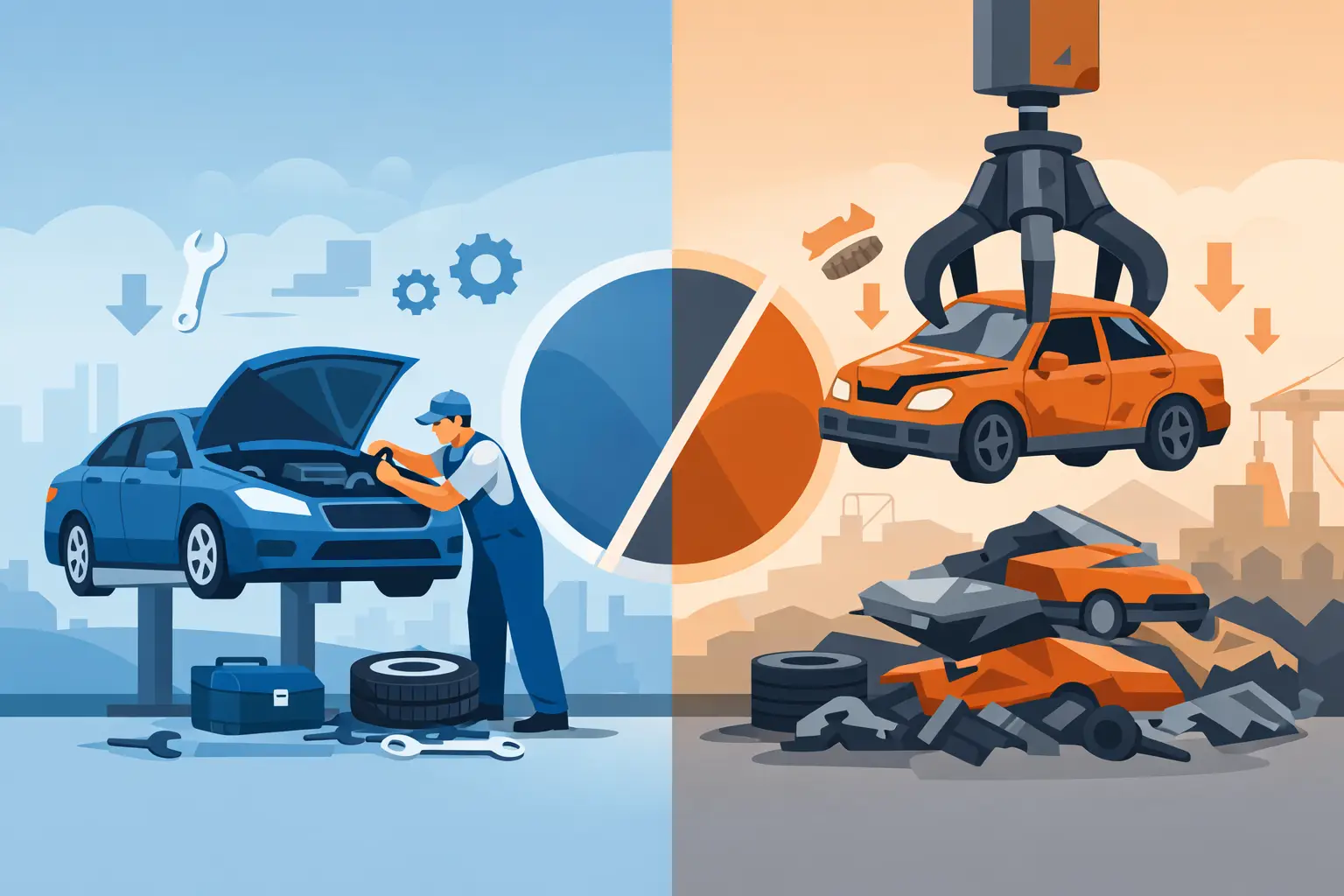
That moment usually comes without much warning. The car fails, the garage rings, and the quote lands somewhere between annoying and ridiculous. Suddenly, repairing versus scrapping cars is not a theoretical question – it is a decision that affects your time, your money and how quickly you can move on.
For most drivers, the right answer is not emotional. It comes down to value, reliability and hassle. A cheap repair on a dependable car can be well worth doing. A large bill on an ageing, non-running vehicle often is not. The trick is knowing where that line sits before you spend more than the car is realistically worth.
Repairing versus scrapping cars: start with the real numbers
The first thing to ignore is what you have already spent on the vehicle. New tyres last year, a recent service or a battery fitted two months ago can make you want to keep going. But sunk costs do not make the next repair better value.
Instead, compare three figures. Look at the repair cost, the current market value of the car if it were running properly, and the scrap value as it stands. If the repair is a modest percentage of the car’s usable value and the rest of the vehicle is sound, repairing may be sensible. If the bill is high and there is a strong chance more faults will follow, scrapping becomes the more practical option.
A common rule of thumb is simple enough. If a repair costs close to, or more than, the vehicle’s value, it rarely makes financial sense unless the car is unusually reliable, low mileage or difficult to replace cheaply. Even then, you need to be honest about the next six to twelve months, not just the current fault.
When repairing makes sense
Repairing a car can still be the right move, even on an older vehicle. Age alone does not make a car scrap. What matters is condition, reliability history and the type of fault.
If the issue is isolated and the car has otherwise been dependable, a repair can be the cheapest way to stay mobile. This is often true where the bodywork is good, the MOT history is reasonable, and there are no signs of repeated major mechanical trouble. A straightforward repair can give you another year or two without the cost and risk of buying a replacement.
It also makes sense to repair if replacing the car would cost far more than fixing it. Used car prices are still high enough in many cases that a sensible repair bill can compare favourably with shopping for another vehicle. That is especially true if you know your own car’s history and trust it more than an unknown second-hand option.
There is also the practical side. If the car is needed for commuting, school runs or caring responsibilities, a quick repair may be the least disruptive choice. Scrapping and replacing a vehicle sounds simple until you factor in time spent searching, viewing, insuring and taxing the next one.
Repairs that are often worth considering
Items such as brakes, tyres, exhaust sections, batteries and some suspension work are usually part of normal ownership. They are not enjoyable bills, but they do not automatically mean the end of the car. If the rest of the vehicle is in decent shape, these repairs are often routine rather than terminal.
The same applies to some MOT failures. A failed MOT can sound dramatic, but not every fail means the car is finished. What matters is the total cost of putting it right and whether the vehicle is likely to keep needing money soon after.
When scrapping is the smarter move
There is a point where repairing stops being sensible and starts becoming a drain. That usually happens when the fault is major, the car is low in value, or the vehicle has already become unreliable.
Engine failure, gearbox problems, severe corrosion, electrical faults and heavy accident damage can quickly tip the balance. These are the kinds of repairs that often start with one estimate and end with another. Even if the initial work is completed, other hidden issues can surface once the vehicle is stripped down or tested properly.
Scrapping is also often the better route for non-runners. If a car will not start, cannot be driven legally or safely, or has been sitting unused for months, the practical cost of keeping it rises fast. You may be paying for recovery, storage or driveway space on top of the repair itself.
Then there is reliability. A car that keeps coming back with new faults is expensive in ways that do not always show on the invoice. It costs time off work, breakdown stress and repeated garage visits. At some stage, cutting your losses is not giving up – it is making a better decision.
Repairing versus scrapping cars after an MOT failure
An MOT fail is one of the most common triggers for this decision, and it deserves a clear-headed look. Many owners see a fail sheet and assume the car must be scrapped. Others approve every repair because they want to keep the car going. Neither reaction is always right.
The better approach is to separate the advisories from the actual fail items, then ask what the repaired car would realistically be worth and how long it is likely to last. A £600 MOT repair on a tidy, dependable car may be fine. The same £600 on an old vehicle with corrosion, warning lights and a history of repeat faults may be money you never get back.
If the garage has identified structural rust, serious emissions issues or multiple age-related problems at once, that is often a sign the car is moving into end-of-life territory. In those cases, scrapping can save you from paying to pass one MOT only to face another large bill shortly after.
The hidden costs people forget
This decision is rarely just about the quoted repair figure. There are other costs that matter.
Recovery charges can make a bad situation worse if the vehicle is not roadworthy. Time without a car can mean taxi fares, missed work or rearranged family plans. Insurance and tax may continue while the car sits unused. If the repair takes longer than expected, the inconvenience mounts quickly.
On the other side, replacing a vehicle also carries costs. You may need to pay more upfront than expected, and another used car may arrive with its own problems. That is why the decision is not simply about avoiding repair bills. It is about choosing the lower-risk option overall.
This is where scrapping can be a relief rather than a last resort. If the car is genuinely no longer worth repairing, a straightforward quote, free collection and prompt payment remove a lot of friction. For owners in and around Peterborough, that convenience matters just as much as the final price.
How to make the decision without overthinking it
If you are stuck, ask yourself four practical questions. Is the repair affordable? Is the car otherwise reliable? Would you trust it for the next year? And if you spent the money, would the vehicle still have meaningful value afterwards?
If the answer to most of those is yes, repairing may be worthwhile. If the answer is no, scrapping is likely the stronger move.
It also helps to avoid making the decision based on attachment alone. Plenty of owners keep paying for an old car because it has been with them for years. That is understandable, but sentiment does not improve reliability. A car that has reached the end of the road will keep asking for more.
Equally, do not assume scrapping means you are getting very little back. Depending on the make, model, age and condition, a scrap vehicle can still hold decent value. That is particularly helpful if the alternative is sinking more money into a car with no guaranteed future.
The practical advantage of scrapping a non-runner
Once a vehicle can no longer be driven, the case for scrapping often becomes much stronger. Private selling gets difficult very quickly because buyers expect heavy discounts, ask endless questions, or simply do not turn up. Arranging transport yourself adds another layer of cost and hassle.
A proper scrappage service removes those barriers. You can get a price based on the registration and postcode, arrange collection, and have the paperwork handled correctly. For many sellers, that certainty is worth more than chasing a slightly different figure through a slow and unreliable process.
That is why services such as Scrap Cars Peterborough appeal to people with damaged, unwanted or end-of-life vehicles. The value is not only in the quote. It is in getting the car collected, paid for and dealt with properly without dragging the situation out for another week.
The best choice is the one that leaves you with the least regret next month, not just the lowest bill today. If a repair gives you reliable motoring at a fair cost, fine. If the car is finished, scrapping it quickly and cleanly is often the most sensible way forward. Make the call based on numbers, condition and hassle, then move on with confidence.
Leave a Reply