
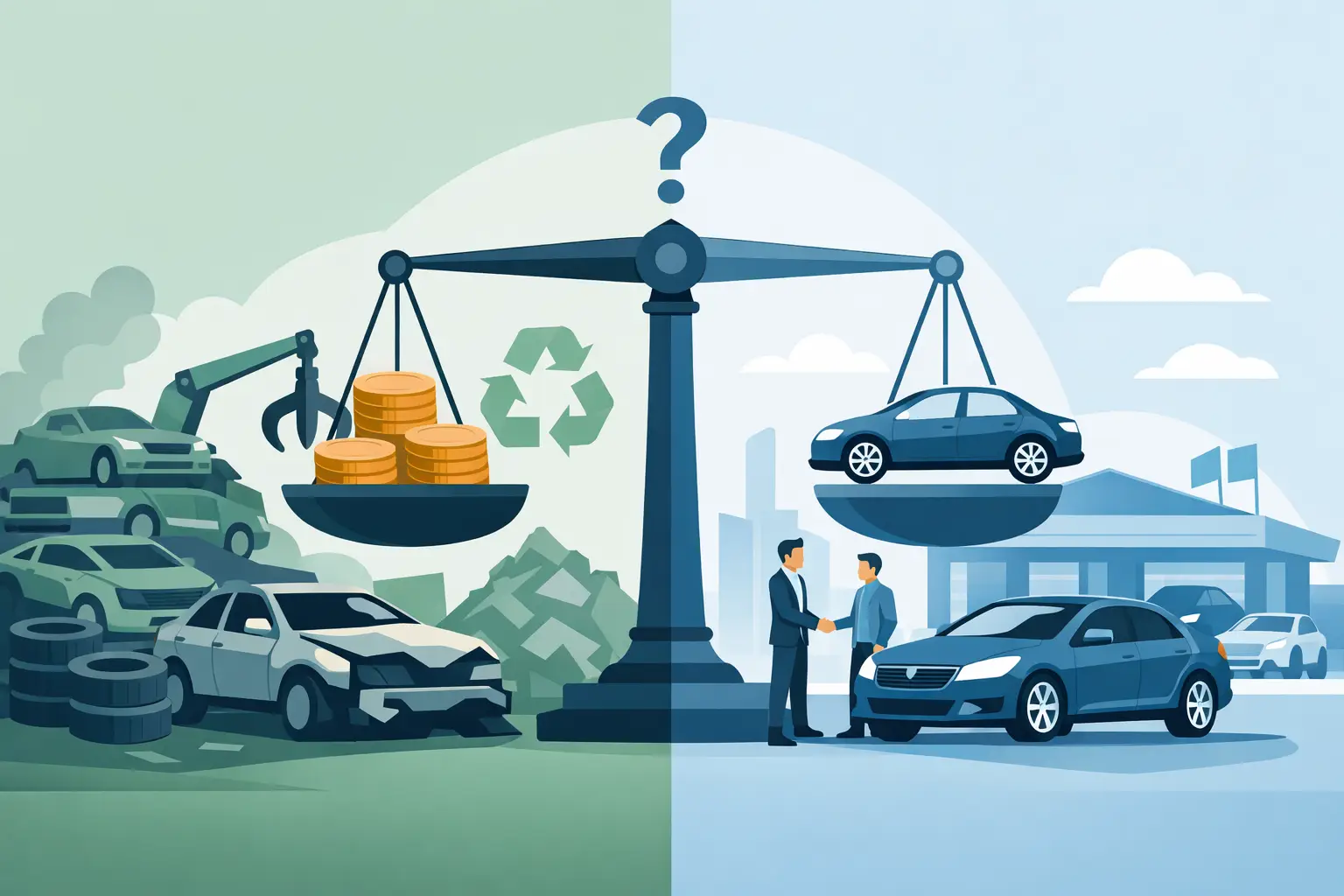
If your car is sitting on the drive with a failed MOT, engine trouble or accident damage, the usual question is not whether it has to go. It is whether a vehicle recycler or dealer is the better route for getting rid of it without wasting time or losing money. The answer depends on the condition of the car, how quickly you need it gone, and whether you want to deal with viewings, negotiation and transport.
For many owners, the decision becomes clear the moment the car stops being practical to sell privately. A dealer may make sense for a roadworthy vehicle with resale value. A recycler is usually the stronger option when the car is old, non-running, uneconomical to repair or simply not worth the hassle of advertising.
Vehicle recycler or dealer – what is the difference?
A dealer is buying with resale in mind. They are usually looking for vehicles they can prepare, price and sell on. That means they will care about service history, mileage, condition, market demand and how much work the car needs before it can sit on a forecourt or be sold through trade channels.
A vehicle recycler is different. They assess the car based on its overall recoverable value as an end-of-life or damaged vehicle. That includes metal value, reusable vehicle materials, make and model demand, weight, and how practical collection is. If your vehicle does not start, has serious faults or has been written off as no longer worth repairing, a recycler is often the more realistic choice.
This is where many sellers lose time. They approach a dealer with a car that is no longer attractive for resale, then get a very low offer or no offer at all. After that, they still need to find someone willing to collect it. If the car cannot be driven, that delay matters.
When a dealer makes sense
A dealer can be the right route if your car is still in usable condition and has clear retail or trade appeal. If it starts, drives, has a current MOT or only needs minor work, a dealer may be willing to offer based on what they believe they can resell it for.
This can work well for newer cars, popular models or vehicles with good history and manageable cosmetic issues. If the car can go straight into stock or be sold on quickly, a dealer has room to pay more than a recycler.
The trade-off is speed and certainty. Dealers tend to be selective. They may reduce their offer after inspection, especially if faults were not obvious at first. You may also need to take the car to them, arrange appointments, or spend time discussing price. For some sellers, that is fine. For someone with a dead car blocking the drive, it usually is not.
When a vehicle recycler is the better choice
If your car is damaged, non-running, very old, failed its MOT badly or has become too expensive to repair, a recycler is normally the practical answer. You are not trying to persuade someone it still has everyday use. You are moving it on through a process designed for exactly that type of vehicle.
That matters more than people think. A car with gearbox failure, flood damage, severe rust, electrical faults or accident damage can sit for weeks while the owner tries the wrong sales route. A recycler removes that friction. The quote is based on the vehicle as it is, not on an optimistic retail value that disappears when the faults are checked.
For local sellers in and around Peterborough, this is often the fastest way to turn an unwanted vehicle into cleared space and same-day progress. A collection-based service is especially useful when the car is not roadworthy and cannot legally or safely be driven anywhere.
Which pays better?
There is no single answer, because the best price depends on the vehicle itself.
If the car is roadworthy, presentable and resalable, a dealer may pay more. They are buying future margin. If the car is at the end of its useful life, a recycler will usually give the stronger real-world offer because they are pricing it for its actual condition rather than trying to protect themselves from repair risk.
What matters is not just the headline figure. You also need to consider collection charges, delays, failed appointments and price drops on arrival. A slightly higher initial offer is not better if the buyer turns up and chips away at the price, or expects you to arrange delivery.
That is why many sellers focus on net return and convenience together. A fair quote, free collection and quick bank payment often beats a drawn-out sale that looks better on paper than it does in practice.
Vehicle recycler or dealer for non-runners and damaged cars
This is usually the easiest call. For non-runners and damaged vehicles, a recycler is almost always the better fit.
Dealers generally do not want stock that requires major mechanical work unless there is a very specific resale opportunity. Even then, offers are cautious. They need room for repair costs, transport, prep work and resale risk. If the car has substantial faults, their bid can be well below what the owner expected.
A recycler is set up for this category of vehicle. They can quote quickly, arrange collection, and handle the process without expecting the seller to fix anything first. That saves money and avoids the common mistake of spending on repairs that never add enough value back.
The paperwork side matters too
One reason people hesitate is uncertainty around the official side of scrapping or selling an end-of-life vehicle. That concern is reasonable. Most private owners do not dispose of cars often, and they do not want a simple sale to turn into paperwork trouble later.
A professional recycler should make this straightforward. The process should be clear, compliant and easy to follow, with support on what is needed from the seller and what happens after collection. That is especially important if the vehicle is no longer in use and you want the handover done properly first time.
Dealers can also handle paperwork correctly, of course, but with very low-value or scrap-condition cars, the process can feel less worthwhile because the transaction itself is often less straightforward. If the vehicle is already beyond economical repair, most owners just want a clean, efficient exit.
Speed versus squeezing every last pound
There is always a balance between maximum value and minimum hassle. If you have time, the car is driveable, and you are happy to test different buyers, you may decide to see what a dealer offers. If your priority is getting the vehicle removed quickly with no towing worries, a recycler is usually the more sensible route.
That is not settling for less. It is choosing the option that matches the car and your situation. A broken vehicle can become expensive simply by sitting there. Insurance, space, inconvenience and stress all have a cost, even if they do not show up as a line on paper.
A service built around instant quotes, free collection and prompt payment usually wins because it removes those hidden costs. That is why many owners use Scrap Cars Peterborough when they want the process handled quickly and properly, without spending days chasing the wrong buyer.
How to choose the right option for your car
Start with a blunt assessment. Is the car roadworthy? Would a buyer realistically want to resell it? Is it worth repairing before sale? If the answer to those questions is doubtful, treat it as a recycling candidate rather than a dealer sale.
Then look at the whole transaction, not just the offer. Ask yourself how the vehicle will be collected, how fast payment is made, and whether the process works if the car does not move under its own power. Those details make the difference between an easy sale and an annoying one.
If your vehicle is old, damaged or dead on the drive, the practical route is usually the best one. The right buyer is not the one with the fanciest promise. It is the one that can give you a fair price, collect when agreed and complete the job without drama.
A car that no longer serves you should not keep taking up your time. Choose the route that fits its real condition, and the rest becomes much simpler.
Leave a Reply